
Body Hair Transplant
In hair transplantation, follicular units from the occipital and temporal scalp are typically harvested and implanted in the bald area to achieve hair regrowth. Sometimes, when the bald area is large, the scalp hair supply is not sufficient to cover the area, and in this situation, we take the help of body hair and extract it from different body areas and implant it on the scalp. Donor hair is most likely scalp hair, but where the supply is not enough to cover bald areas, we can also use body hair as the donor.
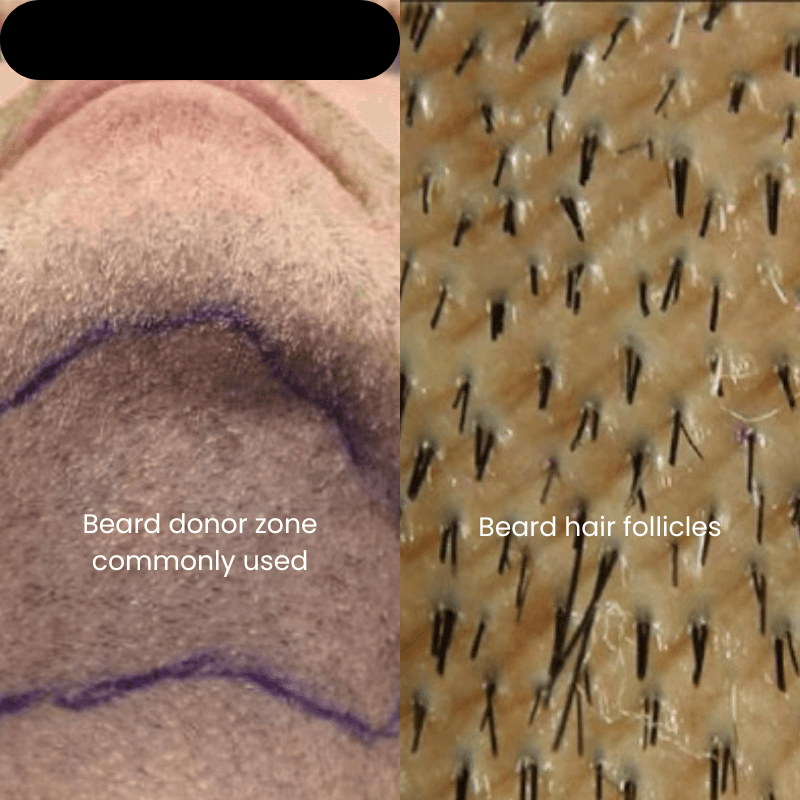
Body hair from various donor sites can be used, with beard hair being the preferred choice due to its closer match to scalp hair characteristics, followed by chest and back hair; finer hair from areas such as the arms and legs is rarely used due to its short growth cycle and limited calibre.
Beard hair
This is the first choice of FUE after scalp hair. It's usually thicker than scalp hair, grows fast, and grows long compared with other body hair. Hair follicles are typically quite ‘sturdy’ and behave well when implanted on the scalp. The preferred area for extraction is usually the beard below the jawline, but this can be modified as per the patient’s preference.
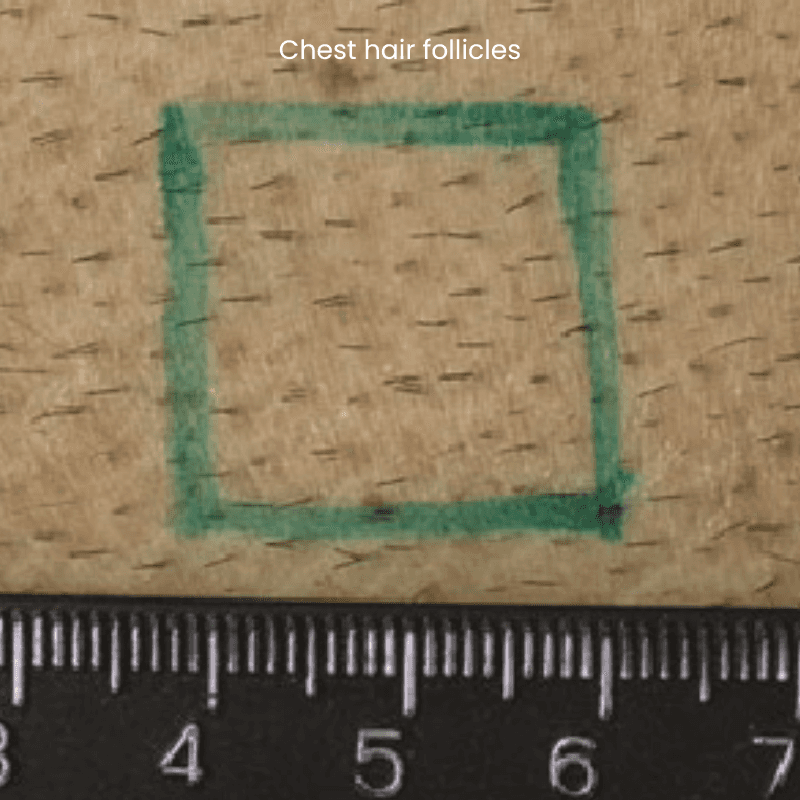
Chest, Abdominal & Back Hair
Next preferred is chest, abdomen and back hair. These hair are vellus hair which are thinner compared to scalp and beard hair, slow to grow, and don’t grow very long. They are often used as fillers to improve density. The softness of these hair make them suitable for use to form fontal hairline.
Axillary and pubic hair are next preferred. These are thicker and grow longer compared to chest and back. However, the number of grafts that can be obtained form these areas may be very small.
The least preferred are hair from hands and legs. In most of the patients they are typically too thin and short to make any visible difference to the results. But they are used when needed.
Procedure for Body Hair FUE
The procedure is similar to scalp hair FUE with some modifications:
The pre-operative and post-operative instructions are different, and are communicated to the patient depending on the surgical plan.
The extraction is technically more challenging compared to scalp hair.
Implantation procedure for this hair is the same as scalp hair, but recipient area planning differs. Planning where to place these grafts, their angle, and direction are decided to help achieve natural-looking results with this ‘less natural hair on scalp’.
At Sinclair Dermatology, we routinely use hair from other body parts for patients who require a higher number of grafts. We commonly perform hair transplants in big bald areas where we use body hair from different body areas. Our experience with cases requiring a large number of grafts and from different body areas, along with the right instrumentation, has enabled us to achieve good growth with body hair transplants.
Combined Scalp Hair & Body Hair Transplant Gallery

